Core Fields: Incidents
The fields available for the Incidents module, and what each one is for
Contents
- 1. Introduction & Context
- 2. Key Features & Functions
- 3. Requirements
- 4. Step-by-Step Guide
- 5. Common Issues & Troubleshooting
- 6. Related Articles
1. Introduction & Context
This article lists the fields available for the Incidents module and what each one is for, and shows how to choose which fields appear as columns in the Incidents list view.
Who is it for? This is configured by Clew Admins in Admin Settings, under Custom Types > Incident.
What does it impact? These settings control what your team sees and can enter on Incident records, not the underlying data itself.
2. Key Features & Functions
- Field coverage: covering ownership and reporting, incident description and classification, consequence assessment, investigation tracking, dates and scheduling, and record/system fields, listed in full in Section 4.
- Default list view columns: out of the box, the Incidents list view shows Type, ID #, sensitivity, Title, Status, Register, Location, Business , Reporter, and Occurred at.
3. Requirements
- Clew Admin access, to open Admin Settings and Custom Types > Incident.
- The Incidents module must already be enabled in Clew.
4. Step-by-Step Guide
Incidents: Core Field Visibility
- Go to Admin Settings and open Custom Types.
- Select Incidents.
- Scroll to Core Field Settings. Use the search box to find a specific field if the list is long.
- Update fields individually using the eye icons, or select several rows and use Mass Edit. See Core Fields: Overview for how these controls work.
By default, the Incidents list view's Selected Fields include Type, ID #, sensitivity, Title, Status, Register, Location, Business Unit, Reporter, and Occurred at.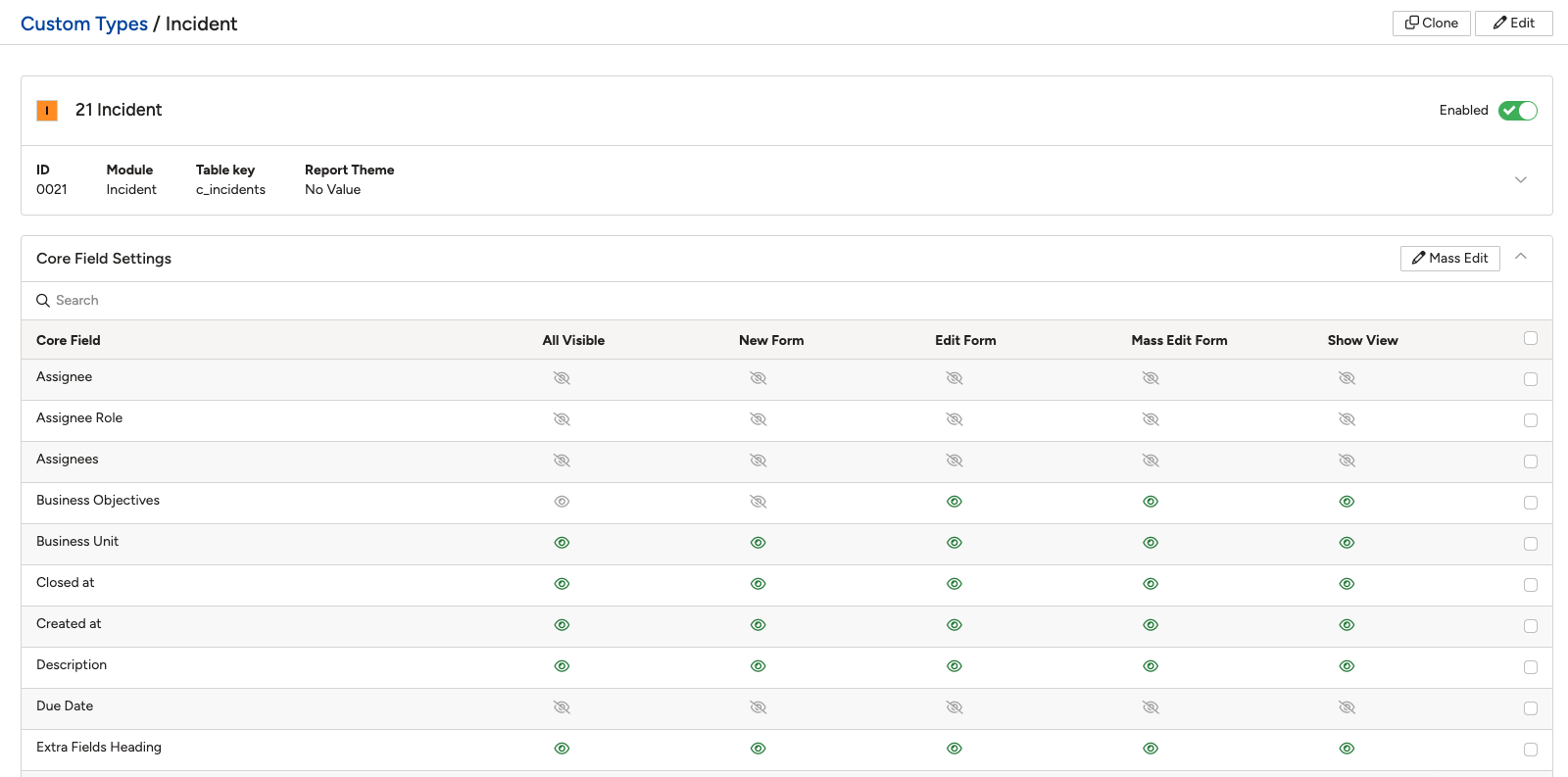
Incidents: Field Reference
The fields available for the Incidents module, grouped by what they're used for. For how to control where each one appears (New Form, Edit Form, Mass Edit Form, Show View), see Core Fields: Overview.
Ownership & Reporting
| Field | What it's for |
| Owner | The person accountable for managing the incident. |
| Owner Role | The role the Owner holds. |
| Assignee | The person the record, or an action arising from it, is currently assigned to. |
| Assignees | Everyone currently assigned to the record, where more than one person can be assigned. |
| Assignee Role | The role the assignee holds, shown alongside or instead of their name. |
| Opened by | The user who opened the incident record in Clew. |
| Reporter | The person who reported the incident. |
Incident Description & Classification
| Field | What it's for |
| Description | A written description of what happened. |
| Incident Types | The type(s) of incident this record is classified as. |
| Type of Breach | The specific type of breach involved, where the incident relates to a breach. |
| Business Objectives | The organisational objective(s) that this incident relates to or could affect. |
| Immediate Actions | The actions taken straight away in response to the incident. |
| Location | The physical or organisational location the incident relates to. |
Consequence Assessment
| Field | What it's for |
| Potential Consequence | A specific potential outcome or impact that could have resulted from the incident. |
| Overall Potential Consequence | The combined or highest-level potential outcome across all factors considered. |
| Actual Consequence | A specific outcome or impact that did result from the incident. |
| Overall Actual Consequence | The combined or highest-level actual outcome across all factors considered. |
Investigation
| Field | What it's for |
| Investigation Type | The type of investigation being carried out into the incident, for example Simple or Advanced. |
| Simple Investigation Created | Flags whether a simple investigation has been created for the incident. |
| Advanced Investigation Created | Flags whether an advanced investigation has been created for the incident. |
| All Investigations Complete | Flags whether every investigation raised against the incident has been completed. |
Dates & Scheduling
| Field | What it's for |
| Occurred at | The date and time the incident actually happened. |
| Reported at | The date and time the incident was reported. |
| Due Date | The date the incident, or its actions, is due to be actioned. |
| Original Due Date | The due date originally set, before any extension. |
| Target Close Date | The date the incident is targeted to be closed by. |
Record & System Fields
| Field | What it's for |
| Type | The record type classification, distinguishing this custom type (Incident) within its module. |
| ID # | The unique identifier number automatically assigned to the record. |
| Title | The short name or title given to the incident record. |
| Status | The record's current position in its workflow, for example Draft, Open, or Closed. |
| Register | The register the incident belongs to. |
| sensitivity | Flags whether the record is sensitive, which can restrict who is able to view it. |
| Business Unit | The business unit or department the incident belongs to. |
| Created at | The date and time the record was first created. |
| Updated at | The date and time the record was last updated. |
| UUID | A unique identifier automatically generated for the record, in addition to the sequential ID #. |
5. Common Issues & Troubleshooting
These issues apply to Incidents the same way they do to every module. See Core Fields: Overview for the general troubleshooting table and best practices.
| Issue | Likely Cause | Solution |
| An Incident field doesn't appear on a form or Show View | That specific column is switched off for the field in Incident's Core Field Settings | Open Custom Types > Incident > Core Field Settings and switch on the relevant column for that field |
| A field isn't listed under Incident's Available Fields or Core Field Settings at all | The field has not been enabled for your organisation | Raise a request with Clew support to have the field enabled for Incidents |
- Core Fields: Overview
- Core Fields: Risk
- Core Fields: Hazards
- Core Fields: Action
- Core Fields: Assurance (Audit Report)
- Core Fields: Audit
- Core Fields: Business Objective
- Core Fields: Change Request (Feedback)
- Core Fields: Control
- Core Fields: Library Control
- Core Fields: Learning (Declaration)
- Core Fields: Standard
- Core Fields: Performance Standard
- Core Fields: Measurement
Was this article helpful?
That’s Great!
Thank you for your feedback
Sorry! We couldn't be helpful
Thank you for your feedback
Feedback sent
We appreciate your effort and will try to fix the article